If you are comparing liposuction vs tummy tuck, you are likely trying to answer one question:
Which procedure will actually fix my abdomen?
These two surgeries are often confused. They are not interchangeable. They treat different problems.
Liposuction removes unwanted fat; tummy tuck removes excess skin and may tighten abdominal muscles.
At The Williams Center in Albany and Latham, Dr. Lloreda frequently evaluates patients who initially assume liposuction will fix a lower belly bulge, when the real issue is loose skin or muscle separation. The right choice depends on what is actually causing the contour concern.
This guide will help you understand the difference and decide which option makes sense for your body.
Quick Comparison: Liposuction vs Tummy Tuck
|
Feature |
Liposuction |
Tummy Tuck |
| Removes fat | Yes | Yes, often combined |
| Removes loose skin | No | Yes |
| Tightens abdominal muscles | No | Yes, when needed |
| Scar size | Small incision marks | Lower abdominal scar |
| Best for | Localized fat deposits | Loose skin and muscle separation |
| Recovery time | Shorter | Longer |
If your concern is fat alone, liposuction may be enough.
If your concern includes loose skin or muscle separation, liposuction alone will not correct it.
What Liposuction Actually Fixes
Liposuction is designed to remove localized fat deposits that do not respond to diet and exercise.
It works best when:
- Skin elasticity is good
- The abdominal wall is firm
- There is minimal or no muscle separation
- The concern is isolated fat
It does not remove excess skin. It does not tighten stretched abdominal muscles.
Medical sources consistently describe liposuction as a fat-removal procedure, not a skin-tightening operation. If loose skin is present, removing fat alone can sometimes make laxity more noticeable.
For patients in Albany considering body contouring, liposuction is often appropriate when the skin snaps back naturally, and the abdominal wall remains tight.
What a Tummy Tuck Actually Fixes
A tummy tuck, or abdominoplasty, addresses structural changes in the abdomen.
It can:
- Remove excess loose skin
- Tighten separated abdominal muscles
- Improve lower abdominal contour
- Reposition or refine a low abdominal scar in some cases
Abdominoplasty is commonly described in medical literature as removing excess skin and fat while repairing the abdominal wall when necessary.
It is often recommended after pregnancy or significant weight loss, when the issue is not just fat, but stretched tissues.
If you can pinch loose skin or see wrinkling when you bend forward, that is typically not a liposuction problem.
The Most Common Mistake: Choosing Liposuction When You Need Skin Tightening
One of the most common misunderstandings is assuming liposuction will flatten a postpartum lower belly.
If the bulge is caused by:
- Loose skin
- Muscle separation
- Significant abdominal laxity
Then removing fat alone will not fix the underlying issue.
In fact, reducing fat volume without addressing skin laxity can sometimes make loose skin appear more obvious.
This is why a proper examination matters. The solution depends on the structure beneath the skin.
Who Is a Better Candidate for Liposuction?
Liposuction may be appropriate if you:
- Have firm, elastic skin
- Do not have significant muscle separation
- Are close to your goal weight
- Have localized fat pockets
If you lie flat and your abdomen appears smooth but fuller in specific areas, fat may be the primary issue.
Who Is a Better Candidate for a Tummy Tuck?
A tummy tuck is usually more appropriate if you:
- Have loose or hanging abdominal skin
- Notice wrinkling or folds when bending
- Have visible muscle separation
- Have a persistent lower abdominal protrusion after pregnancy
- Experienced major weight loss
If stretch marks are concentrated below the belly button and the skin feels thin or lax, that often suggests skin removal may be required.
Mini Tummy Tuck vs Liposuction
A mini tummy tuck targets the lower abdomen only. It involves a smaller incision and typically does not address upper abdominal laxity.
It may be appropriate if:
- Loose skin is limited to below the belly button
- Muscle separation is mild
- The upper abdomen remains tight
A mini tummy tuck is not the same as liposuction. It removes skin. Liposuction does not.
If you are unsure which applies to you, reviewing this mini tummy tuck page can clarify those distinctions.
Can You Combine Liposuction and Tummy Tuck?
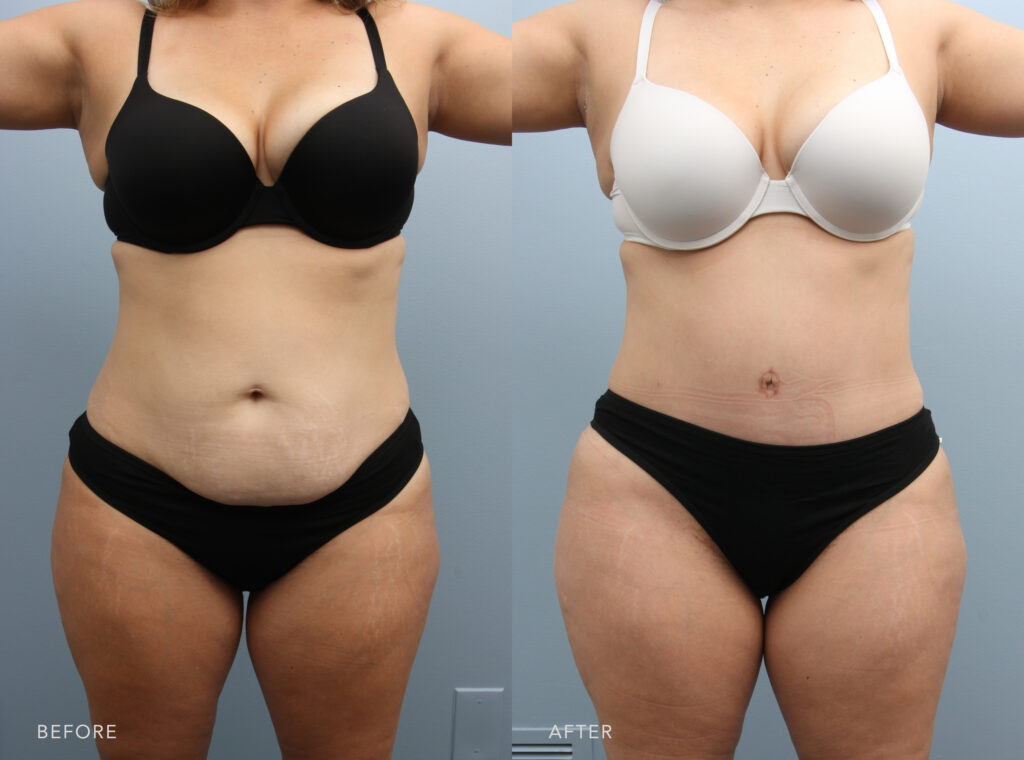
Yes. In many cases, liposuction is performed in combination with a tummy tuck to improve the contour of the waist or flanks.
This approach allows:
- Skin tightening
- Muscle repair
- Fat contouring
Combination procedures require careful patient selection and surgical planning. Not everyone needs both.
The goal is balance. Removing skin without contouring the surrounding fat may leave the waist looking less defined. Adding liposuction can refine the final shape.
Recovery Differences
Recovery expectations differ significantly.
Liposuction Recovery
- Swelling and bruising
- Compression garments
- Return to light activity relatively quickly
- Minimal lifting restrictions in most cases
Tummy Tuck Recovery
- More swelling and tightness
- Longer lifting restrictions
- Possible muscle repair discomfort
- Gradual return to exercise over several weeks
Because a tummy tuck involves skin excision and sometimes muscle tightening, recovery is longer and more structured.
For a detailed week-by-week breakdown, refer to the full tummy tuck recovery guide on our site.
Scar Differences
Scar expectations are different and should be discussed honestly.
Liposuction involves small incision marks placed strategically. These typically fade over time but remain small.
A tummy tuck involves a low horizontal abdominal scar. It is designed to be concealed beneath underwear or swimwear, but it is longer than liposuction incisions.
Scar maturation takes months. Final scar appearance depends on individual healing patterns.
Cost Differences
A tummy tuck is generally more expensive than liposuction.
This is because:
- It is a longer operation
- It may involve muscle repair
- It requires more operating room time
- Recovery management is more involved
Exact pricing depends on anatomy, surgical plan, and whether procedures are combined.
How Dr. Lloreda Helps You Decide
Choosing between liposuction and a tummy tuck is not about preference. It is about anatomy.
During consultation at The Williams Center in Albany or Latham, Dr. Lloreda evaluates:
- Skin elasticity
- Presence of muscle separation
- Fat distribution
- Overall health and stability
- Desired outcome
You will receive a recommendation based on structure, not trend:
- Some patients need liposuction
- Some need a tummy tuck
- Some benefit from both
- Some need neither
The decision should be individualized.
Frequently Asked Questions
Is liposuction less invasive than a tummy tuck?
Yes. Liposuction involves small incisions and fat removal only. A tummy tuck includes skin excision and sometimes muscle repair, making it a more extensive procedure.
Will liposuction fix my lower belly pouch?
Only if the pouch is caused primarily by fat. If loose skin or muscle separation is present, liposuction alone will not correct it.
Does a tummy tuck include liposuction?
Often it can, but not always. The need for liposuction depends on contour goals.
Is recovery much longer with a tummy tuck?
Yes. Recovery is typically longer due to skin removal and possible muscle repair.
Can liposuction tighten loose skin after pregnancy?
No. Liposuction removes fat but does not tighten stretched skin.
Still Unsure? Schedule a Consultation in Albany or Latham
If you are unsure whether liposuction or a tummy tuck is right for you, the next step is a proper evaluation.
At The Williams Center, Dr. Lloreda takes time to assess your anatomy and explain which option aligns with your goals. The goal is not to sell a procedure. It is to choose the right one.
If you are in Albany, Latham, or the surrounding area, we invite you to schedule a consultation to review your options and build a plan that fits your body.